'%3e%3cpath%20fill-rule='evenodd'%20clip-rule='evenodd'%20d='M72.7386%2031.9427H70.5078V34.2699H73.5513L74.8841%2037.6969H78.3056L72.2835%2022.6738H70.4996V25.6665L72.7386%2031.9427ZM70.5078%2031.9427H68.2688L70.4265%2025.6745H70.4996V22.6818H68.7889L62.8359%2037.7049H66.038L67.3748%2034.2779H70.4996L70.5078%2031.9427Z'%20fill='%23005BAA'/%3e%3cpath%20fill-rule='evenodd'%20clip-rule='evenodd'%20d='M89.5501%2025.455C88.5675%2025.0218%2087.5025%2024.7977%2086.4253%2024.7975C85.385%2024.7975%2083.9872%2025.2319%2083.9872%2026.9095C83.9872%2029.4678%2090.7529%2028.372%2090.7529%2033.4766C90.7529%2036.7602%2088.071%2037.9995%2084.9502%2037.9995C83.3248%2037.9995%2082.569%2037.7803%2081.0046%2037.4177L81.3053%2034.7199C82.3888%2035.2638%2083.5831%2035.562%2084.7999%2035.5926C85.9905%2035.5926%2087.5508%2035.0068%2087.5508%2033.6998C87.5508%2030.7749%2080.7852%2032.0181%2080.7852%2026.9852C80.7852%2023.6299%2083.4671%2022.3906%2086.1408%2022.3906C87.4021%2022.395%2088.655%2022.5912%2089.8548%2022.9724L89.5501%2025.455Z'%20fill='%23005BAA'/%3e%3cpath%20fill-rule='evenodd'%20clip-rule='evenodd'%20d='M97.584%2025.0925H93.1914V22.6816H105.093V25.0925H100.709V37.7047H97.584V25.0925Z'%20fill='%23005BAA'/%3e%3cpath%20fill-rule='evenodd'%20clip-rule='evenodd'%20d='M113.344%2025.105C114.466%2025.2445%20115.429%2025.6829%20115.429%2026.9979C115.429%2028.4563%20114.466%2028.8947%20113.344%2029.0421V31.6682C113.795%2031.9551%20114.015%2032.3217%20114.315%2033.0549L116.176%2037.7172H119.598L117.139%2031.8794C116.847%2031.1461%20116.327%2030.3452%20115.514%2030.2854C116.384%2030.1857%20117.185%2029.7724%20117.762%2029.1258C118.339%2028.4793%20118.65%2027.6456%20118.635%2026.7867C118.635%2023.3597%20116.034%2022.8456%20113.352%2022.7021L113.344%2025.105ZM111.19%2025.105H113.344V22.7141H108.086V37.7372H111.207V31.5088H112.149C112.553%2031.4694%20112.96%2031.5198%20113.34%2031.6562V29.0302C112.946%2029.0878%20112.547%2029.1079%20112.149%2029.0899H111.186L111.19%2025.105Z'%20fill='%23005BAA'/%3e%3cpath%20fill-rule='evenodd'%20clip-rule='evenodd'%20d='M131.422%2031.9427H129.191V34.2699H132.32L133.584%2037.6969H137.001L130.979%2022.6738H129.191V25.6665L131.422%2031.9427ZM129.191%2031.9427H126.964L129.191%2025.6745V22.6818H127.484L121.531%2037.7049H124.75L126.082%2034.2779H129.207L129.191%2031.9427Z'%20fill='%23005BAA'/%3e%3cpath%20fill-rule='evenodd'%20clip-rule='evenodd'%20d='M80.9241%206.77433C77.1329%207.06523%2069.7658%208.15709%2063.7437%209.16527C57.7907%2010.1854%2054.8041%2010.9186%2052.2888%2011.5004C45.6694%2013.0346%2035.6285%2015.8838%2030.2729%2017.4778C25.5999%2019.0359%2013.1616%2024.0648%2012.7918%2023.9971C12.6415%2023.9971%2012.1904%2023.5587%2012.8609%2023.1204C11.6012%2023.9971%2031.0124%207.14492%2062.8416%202.91695V0H0V33.4732C19.334%2025.8182%2040.6104%2022.8255%2062.8457%2022.8255V14.7441L63.3699%2014.5967C76.0885%209.93037%2090.8918%208.02957%20114.911%205.55097V4.75399C112.904%204.75399%2098.0272%204.96917%2081.2207%206.79425L80.9241%206.77433Z'%20fill='%23005BAA'/%3e%3cpath%20fill-rule='evenodd'%20clip-rule='evenodd'%20d='M114.912%204.29948C103.641%203.56019%2092.3313%203.60946%2081.0676%204.44692C75.1959%204.88526%2068.9463%205.76194%2063.1477%206.71034C50.7947%208.82234%2040.5385%2011.3767%2040.5385%2011.3767C40.5385%2011.3767%2039.7908%2011.3767%2040.4613%2010.9423C41.5788%2010.2848%2050.6484%206.272%2063.1477%203.86512C65.8269%203.35506%2068.6523%202.91672%2071.6241%202.55011C72.0711%202.55011%2071.6241%202.04004%2071.6241%202.04004C68.7268%202.25921%2065.8255%202.40665%2063.0908%202.76928C51.3864%204.41589%2040.0139%207.83588%2029.3802%2012.9069C28.9332%2013.13%2030.5668%2012.1776%2021.046%2017.358C21.046%2017.358%2015.0971%2021.2233%2014.6542%2021.6617C14.0569%2022.2475%2019.5588%2019.8366%2023.4272%2018.4499C26.999%2017.2145%2036.6701%2014.5128%2038.9009%2013.8553C40.4613%2013.4209%2045.9633%2012.2613%2051.6887%2011.1575C57.0484%2010.0616%2062.1765%209.4121%2062.4772%209.34037H62.847C62.847%209.34037%2068.7268%208.45971%2069.9093%208.24054C71.7013%207.87393%2081.4455%206.71034%2081.5187%206.71034C98.3292%204.88526%20115.209%204.7418%20114.912%204.7418V4.29948Z'%20fill='%2395B6DF'/%3e%3c/g%3e%3cdefs%3e%3cclipPath%20id='clip0_118_10024'%3e%3crect%20width='137'%20height='38'%20fill='white'/%3e%3c/clipPath%3e%3c/defs%3e%3c/svg%3e)






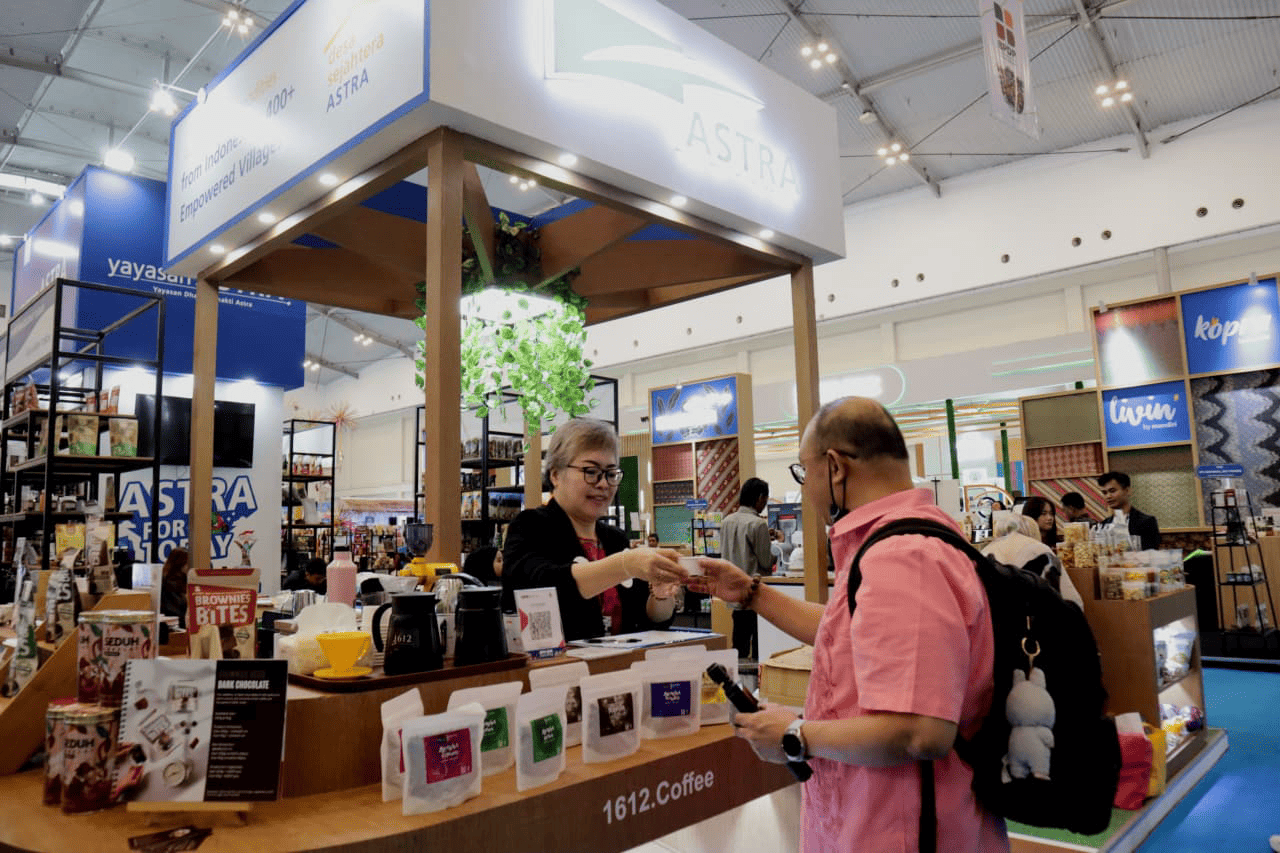
A well-managed village enterprise can unlock local potential and drive lasting economic growth in the community. Here's what that looks like in practice.
Program Kontribusi Sosial
6 mins read
0
Bagikan:
Every village has unique potential. When managed effectively, this potential can generate income for residents and drive broader economic growth. Village enterprises are therefore essential for fostering local economic independence.
A common form of village enterprise is the Village-Owned Enterprise, or BUM Desa. This institution enables village governments and communities to manage local assets and resources for economic and social value. However, village enterprise development is not limited to BUM Desa alone.
So, how can village enterprises expand to create broader impact? The following sections outline key considerations.
ALSO READ: Local Products and How Villages Develop Their Potential
A village enterprise is an economic activity built around a village's own potential, needs, and resources, designed to benefit the local community. It can take the form of local product management, services, agriculture, livestock, tourism, handicrafts, or ventures run through a BUM Desa.
At its core, a village enterprise is not solely focused on profit. It also aims to create jobs, increase community income, optimize village assets, and expand market access for local products.
BUM Desa stands out as an institution specifically built to manage village economic activity, shaped by each village's needs and potential, and run with both village government and community involvement.
Its activities may include public services, production, trade, agriculture, creative enterprises, tourism, and other ventures that leverage local economic potential.
Village enterprises should be viewed as more than profit-driven ventures. They are integral to building an economic ecosystem that provides tangible added value to the community.
Each village can pursue different types of enterprises based on its unique resources. The following are several options to consider.
Processed agricultural and plantation products typically command higher prices than raw materials. Communities can enhance value by investing in processing, packaging, branding, and marketing.
Examples include coffee, coconut sugar, honey, spices, fruit, and processed foods. This approach can also strengthen the local economic network and increase community participation.
Livestock and fisheries can be developed through farming, product processing, or support services. Collective management increases production capacity and expands market reach.
Handicrafts based on local culture serve as both economic products and a way to preserve village identity. Improved design, quality, packaging, and digital marketing can expand their customer base.
Natural and cultural assets can be developed into tourism activities. In addition to attracting visitors, this creates business opportunities for accommodation, culinary services, tour guides, transportation, and local product sales.
Village enterprises may also provide services that address residents' daily needs, including facility rentals, distribution, equipment management, and marketing support for local products.
ALSO READ: Village Innovation Program: Steps For Community Sustainability
To develop a sustainable village enterprise, consider the following steps.
Begin by assessing available resources and the community's actual needs. Promising potential does not guarantee business viability without market demand or alignment with community capabilities. Comprehensive mapping should include natural resources, community skills, village assets, infrastructure, and market opportunities.
A strong product requires effective management to succeed. Communities need expertise in financial management, production, quality control, marketing, and business development.
Local products require access to broader markets. Strategies may include digital marketing, partnerships, exhibitions, business matching, and export opportunities.
Village enterprises are more successful when the community actively participates in their development. This involvement ensures alignment with local needs and fosters a sense of ownership.
Village governments, communities, academics, businesses, and private sector partners each contribute unique strengths to village economic development. Collaboration provides access to knowledge, technology, financing, and broader market networks.
This approach aligns with the foundational principles of BUM Desa, which tailors ventures to local economic and social conditions while ensuring adequate management capacity and business capital.
Desa Sejahtera Astra (DSA) supports villages across Indonesia in turning local potential into value-added products while expanding their market reach. PT Astra International Tbk positions DSA as a program focused on improving village welfare through collaboration with local governments, communities, and Astra's business units.
This approach complements village enterprise development by focusing not only on production but also on building the capacity and ecosystem required for long-term sustainability.
As of 2025, DSA has reached 1,533 villages across 180 regencies. Communities under DSA have seen average income growth of 56.85%, with 3,731 new jobs created. In addition, 492 DSA villages have brought their products to 26 countries, with DSA's export value reaching Rp411 billion as of 2025.
Below are several examples of successful village enterprises supported by Desa Sejahtera Astra.
A notable example is Semedo Village in Banyumas, where Achmad Sobirin, a 2016 SATU Indonesia Awards recipient, established the "Semedo Manise" cooperative and a crystallized coconut sugar business that now exports to 13 countries.
As a DSA Banyumas facilitator, he helped transform the area into a major coconut sugar production hub. The program now benefits approximately 1,100 residents, has increased community income by up to 60%, created 325 jobs, and achieved full market distribution of its products.
In another case, six villages in Flores, East Nusa Tenggara, partnered with DSA and Astra, along with IPB University, to strengthen the Bajawa coffee ecosystem. Efforts included building farmer capacity, establishing production infrastructure, implementing Good Agricultural Practices (GAP), and enhancing the institutional capacity of PT Rumah Kopi Bajawa and Koperasi Produsen Kopi Ekoheto Sejahtera.
This initiative enabled Bajawa coffee to meet export standards, resulting in its first shipment to Thailand and opening opportunities in Japan and Taiwan.
ALSO READ: Unlocking Village Potential: Astra's Strategy to Promote Self-Reliance
Village enterprises can drive local economic growth when potential is effectively managed, the community remains engaged, and products have market access. Ongoing capacity building and collaboration can deliver significant benefits, including higher incomes and job creation.
Desa Sejahtera Astra exemplifies this approach. For more information on PT Astra International Tbk’s sustainability programs and social contributions, including rural community development, please refer to the Astra Sustainability Report.


Be part of our enthusiastic community that is interconnected in the vision of a sustainable future.