'%3e%3cpath%20fill-rule='evenodd'%20clip-rule='evenodd'%20d='M72.7386%2031.9427H70.5078V34.2699H73.5513L74.8841%2037.6969H78.3056L72.2835%2022.6738H70.4996V25.6665L72.7386%2031.9427ZM70.5078%2031.9427H68.2688L70.4265%2025.6745H70.4996V22.6818H68.7889L62.8359%2037.7049H66.038L67.3748%2034.2779H70.4996L70.5078%2031.9427Z'%20fill='%23005BAA'/%3e%3cpath%20fill-rule='evenodd'%20clip-rule='evenodd'%20d='M89.5501%2025.455C88.5675%2025.0218%2087.5025%2024.7977%2086.4253%2024.7975C85.385%2024.7975%2083.9872%2025.2319%2083.9872%2026.9095C83.9872%2029.4678%2090.7529%2028.372%2090.7529%2033.4766C90.7529%2036.7602%2088.071%2037.9995%2084.9502%2037.9995C83.3248%2037.9995%2082.569%2037.7803%2081.0046%2037.4177L81.3053%2034.7199C82.3888%2035.2638%2083.5831%2035.562%2084.7999%2035.5926C85.9905%2035.5926%2087.5508%2035.0068%2087.5508%2033.6998C87.5508%2030.7749%2080.7852%2032.0181%2080.7852%2026.9852C80.7852%2023.6299%2083.4671%2022.3906%2086.1408%2022.3906C87.4021%2022.395%2088.655%2022.5912%2089.8548%2022.9724L89.5501%2025.455Z'%20fill='%23005BAA'/%3e%3cpath%20fill-rule='evenodd'%20clip-rule='evenodd'%20d='M97.584%2025.0925H93.1914V22.6816H105.093V25.0925H100.709V37.7047H97.584V25.0925Z'%20fill='%23005BAA'/%3e%3cpath%20fill-rule='evenodd'%20clip-rule='evenodd'%20d='M113.344%2025.105C114.466%2025.2445%20115.429%2025.6829%20115.429%2026.9979C115.429%2028.4563%20114.466%2028.8947%20113.344%2029.0421V31.6682C113.795%2031.9551%20114.015%2032.3217%20114.315%2033.0549L116.176%2037.7172H119.598L117.139%2031.8794C116.847%2031.1461%20116.327%2030.3452%20115.514%2030.2854C116.384%2030.1857%20117.185%2029.7724%20117.762%2029.1258C118.339%2028.4793%20118.65%2027.6456%20118.635%2026.7867C118.635%2023.3597%20116.034%2022.8456%20113.352%2022.7021L113.344%2025.105ZM111.19%2025.105H113.344V22.7141H108.086V37.7372H111.207V31.5088H112.149C112.553%2031.4694%20112.96%2031.5198%20113.34%2031.6562V29.0302C112.946%2029.0878%20112.547%2029.1079%20112.149%2029.0899H111.186L111.19%2025.105Z'%20fill='%23005BAA'/%3e%3cpath%20fill-rule='evenodd'%20clip-rule='evenodd'%20d='M131.422%2031.9427H129.191V34.2699H132.32L133.584%2037.6969H137.001L130.979%2022.6738H129.191V25.6665L131.422%2031.9427ZM129.191%2031.9427H126.964L129.191%2025.6745V22.6818H127.484L121.531%2037.7049H124.75L126.082%2034.2779H129.207L129.191%2031.9427Z'%20fill='%23005BAA'/%3e%3cpath%20fill-rule='evenodd'%20clip-rule='evenodd'%20d='M80.9241%206.77433C77.1329%207.06523%2069.7658%208.15709%2063.7437%209.16527C57.7907%2010.1854%2054.8041%2010.9186%2052.2888%2011.5004C45.6694%2013.0346%2035.6285%2015.8838%2030.2729%2017.4778C25.5999%2019.0359%2013.1616%2024.0648%2012.7918%2023.9971C12.6415%2023.9971%2012.1904%2023.5587%2012.8609%2023.1204C11.6012%2023.9971%2031.0124%207.14492%2062.8416%202.91695V0H0V33.4732C19.334%2025.8182%2040.6104%2022.8255%2062.8457%2022.8255V14.7441L63.3699%2014.5967C76.0885%209.93037%2090.8918%208.02957%20114.911%205.55097V4.75399C112.904%204.75399%2098.0272%204.96917%2081.2207%206.79425L80.9241%206.77433Z'%20fill='%23005BAA'/%3e%3cpath%20fill-rule='evenodd'%20clip-rule='evenodd'%20d='M114.912%204.29948C103.641%203.56019%2092.3313%203.60946%2081.0676%204.44692C75.1959%204.88526%2068.9463%205.76194%2063.1477%206.71034C50.7947%208.82234%2040.5385%2011.3767%2040.5385%2011.3767C40.5385%2011.3767%2039.7908%2011.3767%2040.4613%2010.9423C41.5788%2010.2848%2050.6484%206.272%2063.1477%203.86512C65.8269%203.35506%2068.6523%202.91672%2071.6241%202.55011C72.0711%202.55011%2071.6241%202.04004%2071.6241%202.04004C68.7268%202.25921%2065.8255%202.40665%2063.0908%202.76928C51.3864%204.41589%2040.0139%207.83588%2029.3802%2012.9069C28.9332%2013.13%2030.5668%2012.1776%2021.046%2017.358C21.046%2017.358%2015.0971%2021.2233%2014.6542%2021.6617C14.0569%2022.2475%2019.5588%2019.8366%2023.4272%2018.4499C26.999%2017.2145%2036.6701%2014.5128%2038.9009%2013.8553C40.4613%2013.4209%2045.9633%2012.2613%2051.6887%2011.1575C57.0484%2010.0616%2062.1765%209.4121%2062.4772%209.34037H62.847C62.847%209.34037%2068.7268%208.45971%2069.9093%208.24054C71.7013%207.87393%2081.4455%206.71034%2081.5187%206.71034C98.3292%204.88526%20115.209%204.7418%20114.912%204.7418V4.29948Z'%20fill='%2395B6DF'/%3e%3c/g%3e%3cdefs%3e%3cclipPath%20id='clip0_118_10024'%3e%3crect%20width='137'%20height='38'%20fill='white'/%3e%3c/clipPath%3e%3c/defs%3e%3c/svg%3e)






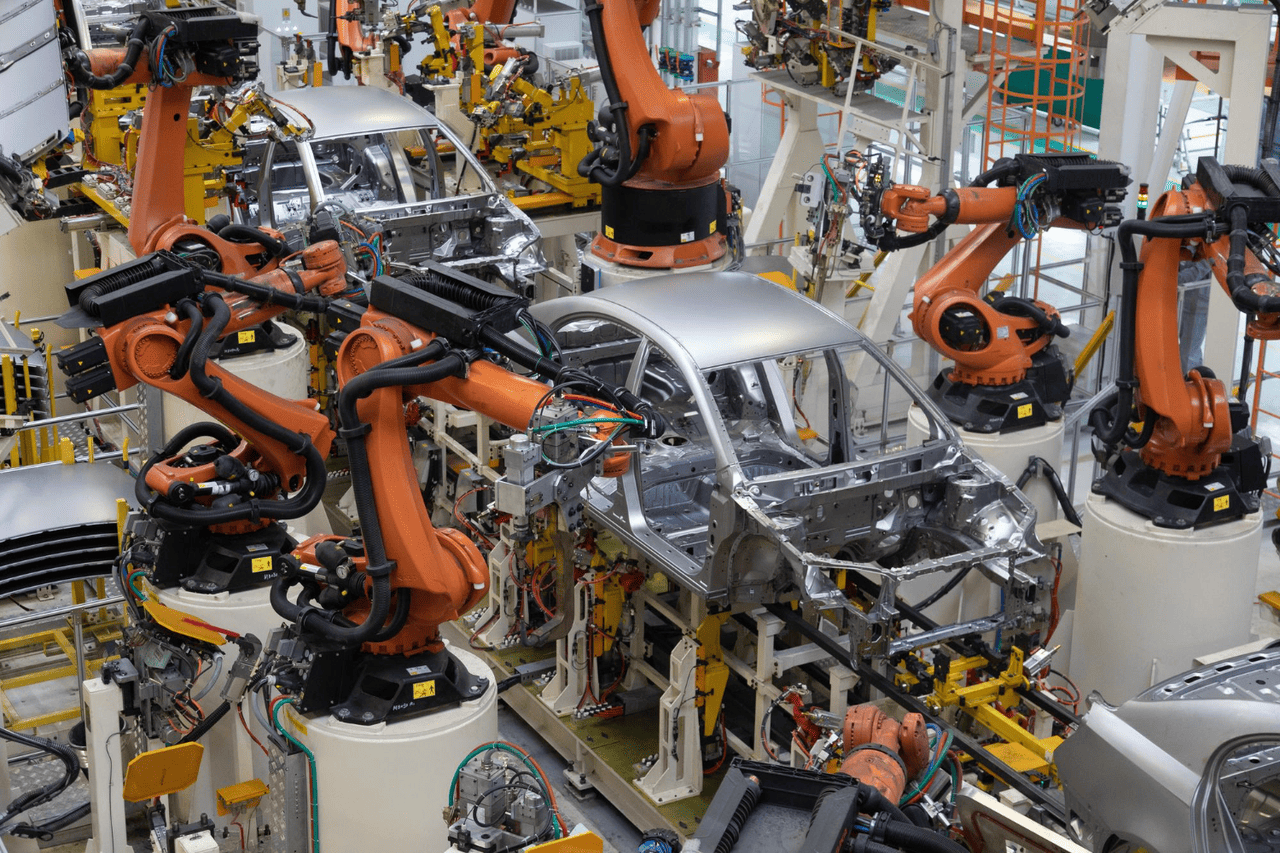
Learn about the potential of Indonesia’s automotive industry, including its challenges, market growth, and the role of technology in driving innovation.
Sustainability
6 mins read
0
Bagikan:
In recent years, Indonesia's automotive industry has experienced rapid growth. From manufacturing and technology to contributions to sustainable development, these areas have become key priorities in the industry's evolution.
But what is the true potential of Indonesia's automotive sector? What challenges does it face? Find the full explanation in this article.
ALSO READ: Road Electrification: The Electric Vehicle Trend in Indonesia
Although it has faced global challenges such as the pandemic and supply chain disruptions, Indonesia's automotive industry has continued to show significant progress. In 2023, four-wheel vehicle sales in Indonesia positioned the country as one of the largest automotive markets in Southeast Asia.
On the production side, national vehicle output also increased, with more than 1.5 million units exported to various countries, including the Philippines and Thailand. This has helped the automotive sector contribute around 4-5% of Indonesia's Gross Domestic Product (GDP), making it one of the country’s strategic economic sectors.
Indonesia is also strengthening its position as a Southeast Asian automotive manufacturing base. Several factors support this position, including competitive labor costs, abundant natural resources, and government policy support.
In addition, technological trends over the past few years have reshaped Indonesia's automotive landscape. Electric vehicles (EVs) are gaining traction, supported by government incentives such as tax reductions and purchase subsidies.
Indonesia's automotive industry faces several challenges, including:
Indonesia is still in the transition phase toward Euro 4 emissions standards, while many developed countries have already moved on to Euro 5 and Euro 6.
Complying with these stricter standards requires major investment in engine technology and fuel quality, which can increase both vehicle and fuel prices.
Government changes to tax policies, including the luxury goods sales tax (PPnBM) and vehicle taxes, affect vehicle competitiveness. Uncertainty around tax policies can also discourage investment from both local and global manufacturers.
One of the biggest barriers to EV adoption is the lack of adequate charging infrastructure. At present, EV charging stations are still concentrated in major cities.
This remains a challenge for consumers, especially those in remote areas, who are considering electric vehicles.
As an archipelagic country, Indonesia also faces major logistics challenges. Shipping vehicles to remote regions is often costly, which can ultimately drive up retail prices.
Younger generations tend to have different preferences when it comes to vehicles. They are more interested in environmentally friendly cars and digitally connected features.
As a result, manufacturers must continue innovating to meet these expectations. In practice, doing so often requires major changes in product design and business models.
Indonesian consumers are highly price-sensitive, but they also expect comprehensive features. This puts pressure on automakers to balance competitive pricing with advanced technology, especially in the electric vehicle segment.
Most vehicle components in Indonesia are still imported. This makes the automotive industry vulnerable to foreign exchange fluctuations and can increase production costs.
Consumer awareness of environmental issues has grown significantly in recent years. As a result, demand for energy-efficient and low-emission vehicles continues to rise.
Manufacturers must adapt to these needs to keep their products relevant in the market.
ALSO READ: Hybrid Cars: A Fuel-Efficient and Eco-Friendly Solution
Despite the challenges, Indonesia's automotive industry also offers major opportunities. Here are some of the key areas that could strengthen the country's position in this sector.
The Indonesian government has shown a strong commitment to developing electric vehicles through tax incentives and subsidies. One example is the elimination of the luxury goods sales tax (PPnBM) on electric vehicles, along with direct consumer subsidies for EV purchases.
In addition, Presidential Regulation No. 55 of 2019 on the Acceleration of Battery Electric Vehicle Programs for Road Transportation provides a clear regulatory foundation for EV market growth. This has encouraged both global and local manufacturers to invest in the EV segment.
The rise of connected vehicles equipped with Internet of Things (IoT) and artificial intelligence (AI) technologies also presents a major opportunity for Indonesia's automotive industry. Consumers increasingly want vehicles that can interact with other devices, provide smart navigation, and offer safety features powered by real-time data.
This digital transformation creates room for manufacturers to deliver added value and improve the overall user experience.
The automotive industry is no longer focused solely on hardware. Today, software development is becoming just as important. Indonesia's younger generation has strong talent in information technology, which can support the development of software for smart vehicles.
Examples include infotainment apps, vehicle operating systems, and self-driving features. Collaboration between tech companies and automakers can accelerate the adoption of these innovations.
With competitive production costs, a large workforce, and a strategic location in Southeast Asia, Indonesia has strong potential to become an automotive manufacturing hub for the ASEAN region.
Several global manufacturers, including Toyota, have already used Indonesia as a production base to serve regional demand, including exports to Thailand and the Philippines.
The low-cost green car segment developed in Indonesia has attracted interest in developing markets. Fuel-efficient, affordable vehicles are often an ideal choice for consumers in Africa, South Asia, and Latin America.
Expanding into these markets could strengthen Indonesia's automotive industry's global competitiveness.
Local manufacturers can benefit from partnerships with global companies to improve technology and production capacity. These strategic alliances can enable technology transfer, new product development, and greater manufacturing efficiency.
Local component manufacturing, including parts for electric vehicles, has become increasingly attractive to foreign investors. In addition to increasing domestic production capacity, this investment can also reduce dependence on imports.
With government incentives and strong market potential, this sector has significant room for rapid growth.
ALSO READ: What Is an EV? Today's Eco-Friendly Vehicle
Those are key challenges and opportunities facing Indonesia's automotive industry. In the context of sustainability, the sector is under global pressure to reduce emissions and improve energy efficiency.
This is where Astra's approach to energy efficiency and emissions management becomes relevant to Indonesia's automotive industry transformation. With market potential and supportive policy direction, Indonesia's automotive sector's future will depend on its ability to adapt to global change and commit to sustainability.
You can learn more about how energy efficiency, emissions management, and sustainable innovation have become part of Astra's long-term journey toward Net Zero Emissions 2060 through the Astra Sustainability Report.


Be part of our enthusiastic community that is interconnected in the vision of a sustainable future.