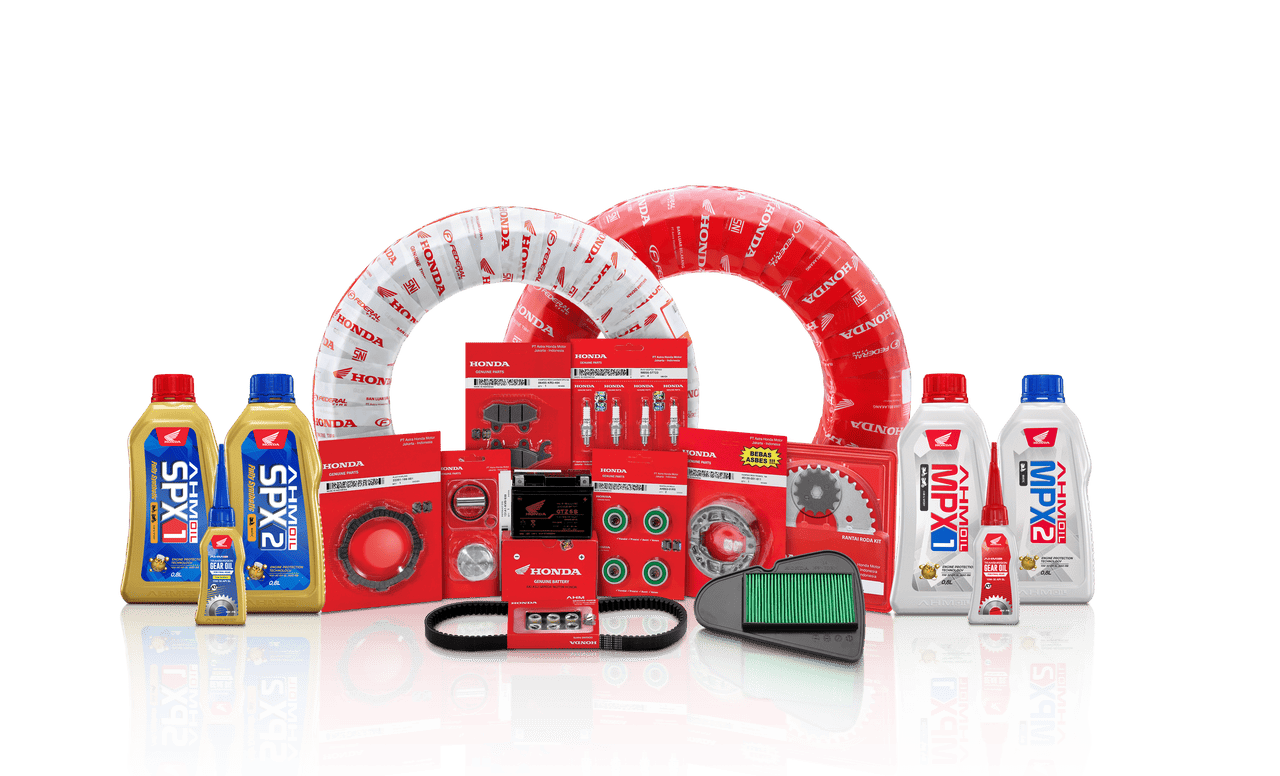
Motorcycles are one of the most widely used modes of transportation in Indonesia because they are practical, efficient, and support everyday mobility. To keep them performing well, regular maintenance and the use of motorcycle spare parts that match the vehicle’s specifications should not be overlooked.
When a component becomes worn or damaged, replacing it with Honda spare parts or parts that meet the manufacturer’s specifications helps maintain performance. Using the right components also supports long-term motorcycle reliability.
So, what types of motorcycle spare parts should you know? Here’s the full explanation.
ALSO READ: 4 Types of Honda Motorcycles: The Best Choices for Daily Needs
What Are Motorcycle Spare Parts?
Motorcycle spare parts are vehicle components that support the motorcycle’s operating systems. They may be part of the engine or supporting systems and can be replaced when they become worn or damaged.
Every motorcycle consists of various component groups that work together. Some parts have a specific service life, so they need regular inspection and replacement.
Understanding each component’s function helps you know when a part should be checked or replaced.
Why Are Motorcycle Spare Parts Important?
Here are several reasons why choosing the right motorcycle spare parts matters.
- Maintain vehicle performance: Components in good condition help the engine work more efficiently and responsibly.
- Support riding safety: Brakes, tires, lights, and suspension all directly affect road safety.
- Extend vehicle lifespan: Replacing worn parts helps prevent damage from spreading to other components.
- Maintain operational efficiency: Proper parts help the motorcycle system work optimally, keeping fuel consumption and performance stable.
Motorcycle Spare Part Components
Here are several key components found in motorcycle spare parts.
1. Ignition System
The ignition system initiates combustion in the engine, allowing the motorcycle to start and run. Its main components include:
- Spark Plug: Creates a spark in the combustion chamber to start combustion. A dirty or worn spark plug can make the motorcycle harder to start and increase fuel consumption.
- CDI (Capacitor Discharge Ignition): Controls ignition timing so combustion occurs precisely.
- Ignition Coil: Converts low battery voltage into high voltage to create a spark at the spark plug.
2. Transmission System
The transmission system transfers power from the engine to the wheels, allowing the motorcycle to move. Key components include:
- Chain and Sprocket: Transfer power from the engine to the rear wheel on non-automatic motorcycles.
- V-Belt and Roller: Crucial components in automatic motorcycles that control power transfer automatically.
- Clutch Lining: Disconnects and reconnects engine power to the transmission and usually needs replacement after a certain period of wear.
3. Braking System
This system is vital for riding safety because it allows the motorcycle to stop properly. Important components include:
- Brake Pads: Wear down over time and must be checked regularly.
- Brake Fluid: Maintains hydraulic pressure in the disc brake system.
- Brake Disc and Drum: Components that make direct contact with the brake pads or shoes to create braking force.
4. Electrical System
The electrical system supports key motorcycle functions, from starting the engine to powering the lights. Its components include:
- Battery: The main electrical power source for starting the motorcycle and powering electronic systems.
- Wiring Harness: Connects all motorcycle electrical components.
- Headlights, Taillights, and Turn Signals: Essential for safety, especially when riding at night.
5. Chassis and Supporting Components
Other important supporting components include:
- Air Filter: Filters dirt from entering the combustion chamber, helping maintain proper combustion quality.
- Engine Oil: Lubricates the engine, helps keep it cool, and reduces excessive friction.
- Tires: Make direct contact with the road and greatly affect riding comfort and safety.
- Shock Absorbers: Reduce impact from road surfaces to keep riding comfortable.
ALSO READ: Honda Electric Motorcycles: Efficient Solution for Modern Mobility
Benefits of Choosing Genuine Motorcycle Spare Parts
Genuine spare parts are designed according to vehicle specifications, providing quality, precise fitment, and performance that meet manufacturer standards.
Choosing the wrong spare parts, especially counterfeit products, can create serious risks. Here’s why genuine spare parts matter.
- Guaranteed material quality: Genuine parts are manufactured to the manufacturer's standards, offering greater consistency in durability and performance.
- Perfect compatibility: Genuine parts are produced for specific motorcycle models, reducing the risk of a mismatch that could damage other components.
- Official warranty: Genuine spare parts usually come with a warranty, giving you extra protection.
- Riding safety: For vital parts such as brakes and electrical components, genuine parts help safety systems work properly.
- Better resale value: Motorcycles maintained with genuine parts tend to have better engine condition and more stable resale value.
When Should You Replace Motorcycle Spare Parts?
Each motorcycle component has a different service life. Here is a general replacement guide.
- Engine Oil: Every 2,000-4,000 km, depending on oil type and usage conditions.
- Spark Plug: Check every 20,000 km and replace if ignition performance declines.
- Brake Pads: Check regularly and replace when they become thin.
- Chain and Sprocket: Replace when loose or worn, usually around 15,000-20,000 km.
- Battery: Average lifespan is 1-2 years, depending on use and maintenance quality.
- Tires: Replace when the tread is worn or the tire exceeds the manufacturer's recommended service life.
Do not wait until a component completely fails. Timely replacement helps prevent larger damage and keeps your ride safer.
Tips for Choosing Motorcycle Spare Parts
To avoid choosing the wrong parts, consider the following tips.
- Match the motorcycle type: Each motorcycle model has different component specifications.
- Use manufacturer-standard components: Properly specified parts help maintain optimal vehicle performance.
- Check the part number: It helps confirm whether a component matches your motorcycle model.
- Buy from official networks or trusted stores: Purchasing from official channels helps ensure the product meets recommended specifications.
- Replace parts according to the service schedule: Follow the maintenance schedule in your owner’s manual so components are replaced at the right time.
ALSO READ: Riding Education Becomes a Priority as Honda Safety Riding Champions Are Put to the Test
Get Genuine, High-Quality Motorcycle Spare Parts Only from PT Astra Honda Motor
From engine components and ignition systems to transmission, braking, and electrical parts, every motorcycle spare part plays a connected role in keeping the vehicle running properly.
To maintain optimal motorcycle performance, ensure every replacement part is Honda-specified and matches your vehicle’s specifications.
Through the PT Astra Honda Motor network, you can find a wide range of Honda Genuine Parts designed to support the quality, precision, and reliability of Honda motorcycles. For more information about official Honda spare parts, visit PT Astra Honda Motor here.
'%3e%3cpath%20fill-rule='evenodd'%20clip-rule='evenodd'%20d='M72.7386%2031.9427H70.5078V34.2699H73.5513L74.8841%2037.6969H78.3056L72.2835%2022.6738H70.4996V25.6665L72.7386%2031.9427ZM70.5078%2031.9427H68.2688L70.4265%2025.6745H70.4996V22.6818H68.7889L62.8359%2037.7049H66.038L67.3748%2034.2779H70.4996L70.5078%2031.9427Z'%20fill='%23005BAA'/%3e%3cpath%20fill-rule='evenodd'%20clip-rule='evenodd'%20d='M89.5501%2025.455C88.5675%2025.0218%2087.5025%2024.7977%2086.4253%2024.7975C85.385%2024.7975%2083.9872%2025.2319%2083.9872%2026.9095C83.9872%2029.4678%2090.7529%2028.372%2090.7529%2033.4766C90.7529%2036.7602%2088.071%2037.9995%2084.9502%2037.9995C83.3248%2037.9995%2082.569%2037.7803%2081.0046%2037.4177L81.3053%2034.7199C82.3888%2035.2638%2083.5831%2035.562%2084.7999%2035.5926C85.9905%2035.5926%2087.5508%2035.0068%2087.5508%2033.6998C87.5508%2030.7749%2080.7852%2032.0181%2080.7852%2026.9852C80.7852%2023.6299%2083.4671%2022.3906%2086.1408%2022.3906C87.4021%2022.395%2088.655%2022.5912%2089.8548%2022.9724L89.5501%2025.455Z'%20fill='%23005BAA'/%3e%3cpath%20fill-rule='evenodd'%20clip-rule='evenodd'%20d='M97.584%2025.0925H93.1914V22.6816H105.093V25.0925H100.709V37.7047H97.584V25.0925Z'%20fill='%23005BAA'/%3e%3cpath%20fill-rule='evenodd'%20clip-rule='evenodd'%20d='M113.344%2025.105C114.466%2025.2445%20115.429%2025.6829%20115.429%2026.9979C115.429%2028.4563%20114.466%2028.8947%20113.344%2029.0421V31.6682C113.795%2031.9551%20114.015%2032.3217%20114.315%2033.0549L116.176%2037.7172H119.598L117.139%2031.8794C116.847%2031.1461%20116.327%2030.3452%20115.514%2030.2854C116.384%2030.1857%20117.185%2029.7724%20117.762%2029.1258C118.339%2028.4793%20118.65%2027.6456%20118.635%2026.7867C118.635%2023.3597%20116.034%2022.8456%20113.352%2022.7021L113.344%2025.105ZM111.19%2025.105H113.344V22.7141H108.086V37.7372H111.207V31.5088H112.149C112.553%2031.4694%20112.96%2031.5198%20113.34%2031.6562V29.0302C112.946%2029.0878%20112.547%2029.1079%20112.149%2029.0899H111.186L111.19%2025.105Z'%20fill='%23005BAA'/%3e%3cpath%20fill-rule='evenodd'%20clip-rule='evenodd'%20d='M131.422%2031.9427H129.191V34.2699H132.32L133.584%2037.6969H137.001L130.979%2022.6738H129.191V25.6665L131.422%2031.9427ZM129.191%2031.9427H126.964L129.191%2025.6745V22.6818H127.484L121.531%2037.7049H124.75L126.082%2034.2779H129.207L129.191%2031.9427Z'%20fill='%23005BAA'/%3e%3cpath%20fill-rule='evenodd'%20clip-rule='evenodd'%20d='M80.9241%206.77433C77.1329%207.06523%2069.7658%208.15709%2063.7437%209.16527C57.7907%2010.1854%2054.8041%2010.9186%2052.2888%2011.5004C45.6694%2013.0346%2035.6285%2015.8838%2030.2729%2017.4778C25.5999%2019.0359%2013.1616%2024.0648%2012.7918%2023.9971C12.6415%2023.9971%2012.1904%2023.5587%2012.8609%2023.1204C11.6012%2023.9971%2031.0124%207.14492%2062.8416%202.91695V0H0V33.4732C19.334%2025.8182%2040.6104%2022.8255%2062.8457%2022.8255V14.7441L63.3699%2014.5967C76.0885%209.93037%2090.8918%208.02957%20114.911%205.55097V4.75399C112.904%204.75399%2098.0272%204.96917%2081.2207%206.79425L80.9241%206.77433Z'%20fill='%23005BAA'/%3e%3cpath%20fill-rule='evenodd'%20clip-rule='evenodd'%20d='M114.912%204.29948C103.641%203.56019%2092.3313%203.60946%2081.0676%204.44692C75.1959%204.88526%2068.9463%205.76194%2063.1477%206.71034C50.7947%208.82234%2040.5385%2011.3767%2040.5385%2011.3767C40.5385%2011.3767%2039.7908%2011.3767%2040.4613%2010.9423C41.5788%2010.2848%2050.6484%206.272%2063.1477%203.86512C65.8269%203.35506%2068.6523%202.91672%2071.6241%202.55011C72.0711%202.55011%2071.6241%202.04004%2071.6241%202.04004C68.7268%202.25921%2065.8255%202.40665%2063.0908%202.76928C51.3864%204.41589%2040.0139%207.83588%2029.3802%2012.9069C28.9332%2013.13%2030.5668%2012.1776%2021.046%2017.358C21.046%2017.358%2015.0971%2021.2233%2014.6542%2021.6617C14.0569%2022.2475%2019.5588%2019.8366%2023.4272%2018.4499C26.999%2017.2145%2036.6701%2014.5128%2038.9009%2013.8553C40.4613%2013.4209%2045.9633%2012.2613%2051.6887%2011.1575C57.0484%2010.0616%2062.1765%209.4121%2062.4772%209.34037H62.847C62.847%209.34037%2068.7268%208.45971%2069.9093%208.24054C71.7013%207.87393%2081.4455%206.71034%2081.5187%206.71034C98.3292%204.88526%20115.209%204.7418%20114.912%204.7418V4.29948Z'%20fill='%2395B6DF'/%3e%3c/g%3e%3cdefs%3e%3cclipPath%20id='clip0_118_10024'%3e%3crect%20width='137'%20height='38'%20fill='white'/%3e%3c/clipPath%3e%3c/defs%3e%3c/svg%3e)