'%3e%3cpath%20fill-rule='evenodd'%20clip-rule='evenodd'%20d='M72.7386%2031.9427H70.5078V34.2699H73.5513L74.8841%2037.6969H78.3056L72.2835%2022.6738H70.4996V25.6665L72.7386%2031.9427ZM70.5078%2031.9427H68.2688L70.4265%2025.6745H70.4996V22.6818H68.7889L62.8359%2037.7049H66.038L67.3748%2034.2779H70.4996L70.5078%2031.9427Z'%20fill='%23005BAA'/%3e%3cpath%20fill-rule='evenodd'%20clip-rule='evenodd'%20d='M89.5501%2025.455C88.5675%2025.0218%2087.5025%2024.7977%2086.4253%2024.7975C85.385%2024.7975%2083.9872%2025.2319%2083.9872%2026.9095C83.9872%2029.4678%2090.7529%2028.372%2090.7529%2033.4766C90.7529%2036.7602%2088.071%2037.9995%2084.9502%2037.9995C83.3248%2037.9995%2082.569%2037.7803%2081.0046%2037.4177L81.3053%2034.7199C82.3888%2035.2638%2083.5831%2035.562%2084.7999%2035.5926C85.9905%2035.5926%2087.5508%2035.0068%2087.5508%2033.6998C87.5508%2030.7749%2080.7852%2032.0181%2080.7852%2026.9852C80.7852%2023.6299%2083.4671%2022.3906%2086.1408%2022.3906C87.4021%2022.395%2088.655%2022.5912%2089.8548%2022.9724L89.5501%2025.455Z'%20fill='%23005BAA'/%3e%3cpath%20fill-rule='evenodd'%20clip-rule='evenodd'%20d='M97.584%2025.0925H93.1914V22.6816H105.093V25.0925H100.709V37.7047H97.584V25.0925Z'%20fill='%23005BAA'/%3e%3cpath%20fill-rule='evenodd'%20clip-rule='evenodd'%20d='M113.344%2025.105C114.466%2025.2445%20115.429%2025.6829%20115.429%2026.9979C115.429%2028.4563%20114.466%2028.8947%20113.344%2029.0421V31.6682C113.795%2031.9551%20114.015%2032.3217%20114.315%2033.0549L116.176%2037.7172H119.598L117.139%2031.8794C116.847%2031.1461%20116.327%2030.3452%20115.514%2030.2854C116.384%2030.1857%20117.185%2029.7724%20117.762%2029.1258C118.339%2028.4793%20118.65%2027.6456%20118.635%2026.7867C118.635%2023.3597%20116.034%2022.8456%20113.352%2022.7021L113.344%2025.105ZM111.19%2025.105H113.344V22.7141H108.086V37.7372H111.207V31.5088H112.149C112.553%2031.4694%20112.96%2031.5198%20113.34%2031.6562V29.0302C112.946%2029.0878%20112.547%2029.1079%20112.149%2029.0899H111.186L111.19%2025.105Z'%20fill='%23005BAA'/%3e%3cpath%20fill-rule='evenodd'%20clip-rule='evenodd'%20d='M131.422%2031.9427H129.191V34.2699H132.32L133.584%2037.6969H137.001L130.979%2022.6738H129.191V25.6665L131.422%2031.9427ZM129.191%2031.9427H126.964L129.191%2025.6745V22.6818H127.484L121.531%2037.7049H124.75L126.082%2034.2779H129.207L129.191%2031.9427Z'%20fill='%23005BAA'/%3e%3cpath%20fill-rule='evenodd'%20clip-rule='evenodd'%20d='M80.9241%206.77433C77.1329%207.06523%2069.7658%208.15709%2063.7437%209.16527C57.7907%2010.1854%2054.8041%2010.9186%2052.2888%2011.5004C45.6694%2013.0346%2035.6285%2015.8838%2030.2729%2017.4778C25.5999%2019.0359%2013.1616%2024.0648%2012.7918%2023.9971C12.6415%2023.9971%2012.1904%2023.5587%2012.8609%2023.1204C11.6012%2023.9971%2031.0124%207.14492%2062.8416%202.91695V0H0V33.4732C19.334%2025.8182%2040.6104%2022.8255%2062.8457%2022.8255V14.7441L63.3699%2014.5967C76.0885%209.93037%2090.8918%208.02957%20114.911%205.55097V4.75399C112.904%204.75399%2098.0272%204.96917%2081.2207%206.79425L80.9241%206.77433Z'%20fill='%23005BAA'/%3e%3cpath%20fill-rule='evenodd'%20clip-rule='evenodd'%20d='M114.912%204.29948C103.641%203.56019%2092.3313%203.60946%2081.0676%204.44692C75.1959%204.88526%2068.9463%205.76194%2063.1477%206.71034C50.7947%208.82234%2040.5385%2011.3767%2040.5385%2011.3767C40.5385%2011.3767%2039.7908%2011.3767%2040.4613%2010.9423C41.5788%2010.2848%2050.6484%206.272%2063.1477%203.86512C65.8269%203.35506%2068.6523%202.91672%2071.6241%202.55011C72.0711%202.55011%2071.6241%202.04004%2071.6241%202.04004C68.7268%202.25921%2065.8255%202.40665%2063.0908%202.76928C51.3864%204.41589%2040.0139%207.83588%2029.3802%2012.9069C28.9332%2013.13%2030.5668%2012.1776%2021.046%2017.358C21.046%2017.358%2015.0971%2021.2233%2014.6542%2021.6617C14.0569%2022.2475%2019.5588%2019.8366%2023.4272%2018.4499C26.999%2017.2145%2036.6701%2014.5128%2038.9009%2013.8553C40.4613%2013.4209%2045.9633%2012.2613%2051.6887%2011.1575C57.0484%2010.0616%2062.1765%209.4121%2062.4772%209.34037H62.847C62.847%209.34037%2068.7268%208.45971%2069.9093%208.24054C71.7013%207.87393%2081.4455%206.71034%2081.5187%206.71034C98.3292%204.88526%20115.209%204.7418%20114.912%204.7418V4.29948Z'%20fill='%2395B6DF'/%3e%3c/g%3e%3cdefs%3e%3cclipPath%20id='clip0_118_10024'%3e%3crect%20width='137'%20height='38'%20fill='white'/%3e%3c/clipPath%3e%3c/defs%3e%3c/svg%3e)






Explore the history of the automobile, from its earliest invention to the modern automotive technology that has transformed how we travel.
Ekosistem EV
8 mins read
0
Bagikan:
Today, the car has become an essential part of modern life. The development and innovation of these four-wheeled vehicles have accelerated dramatically in recent years, and that progress is inseparable from the long history of how the automobile first came into being.
So how did the story of the automobile actually begin? And how has its journey of innovation evolved into the modern vehicle we know today? Find out below!
ALSO READ: Hybrid Cars: A Fuel-Efficient and Eco-Friendly Solution
Here is a look at the automobile's history and how it has evolved across different eras.
Leonardo da Vinci sketched a "concept" for an automobile as early as 1478. Unfortunately, his design did not yet feature an engine and remained nothing more than ideas on paper.
Several centuries later, the first motorised vehicles were finally built. Powered by steam engines, these vehicles were used by the French military in the 1870s to transport heavy military equipment.
The steam engine on these vehicles was supported by three drive wheels. At that time, their speed was believed to be roughly equivalent to that of a person walking on foot.
The diesel engine was first invented in 1882, marking a significant milestone in global automotive history. In January 1882, a diesel-fuelled engine was introduced and began to be widely adopted.
When it first appeared, the diesel engine was hailed as a major breakthrough thanks to its superior fuel efficiency. From that point onward, the diesel engine was continuously refined and became a foundational component of automotive engineering.
This was followed by the emergence of petrol-powered vehicles, also using three drive wheels. This vehicle was created by German engineer Karl Benz in 1885.
Not to be outdone, Henry Ford built his first car in the United States in 1886, laying the foundation for the modern automotive industry as we know it.
In the early 20th century, the simple cars of the previous era began to evolve significantly. When automobiles were first introduced, they did not yet feature the round steering wheel we recognise today.
Before 1900, car steering took the form of a half-circle; and some vehicles even relied on a tiller-like stick to turn the front wheels left and right. It was only after 1900 that round steering wheels began to be adopted, making vehicles much easier to manoeuvre.
Vehicle speeds also began to increase, reaching 15–20 km/h. This was already considerably faster than the average walking pace of around 6 km/h. So much so that the state government of Alabama in the United States imposed a maximum speed limit of just 12 km/h on cars at the time.
This era also saw Ford introduce the iconic Model T. Thanks to the introduction of mechanised production, the manufacturing pace jumped dramatically, from 7.5 units per hour to 146 units per hour. Then in 1913, Ferdinand Porsche introduced the world's first hybrid engine, named the Lohner-Porsche Mixte Hybrid.
By this decade, the automobile had grown into a thriving industry, propelled by a steady stream of new innovations. In the United States, automotive manufacturers proliferated rapidly, from small-scale operations to major industrial players.
However, only the well-capitalised manufacturers managed to survive. From around 253 vehicle producers in 1908, the number had dropped to just 44 by 1929. Of those, 80% of the market was controlled by Ford, Chrysler, and General Motors.
One of the most notable innovations of this era was the introduction of the in-car radio, meaning car owners no longer needed to feel lonely on solo drives.
In the mid-20th century, the automotive industry was inevitably impacted by a world at war. Manufacturers shifted their focus toward producing vehicles capable of serving on the battlefield.
One of the most significant innovations of this era was the four-wheel drive vehicle, perfectly suited for the uneven terrain of military operations.
Notably, these military vehicles were capable of impressive speeds, even when navigating hilly, undulating landscapes. Today, this vehicle is known as the Jeep.
After World War II ended, automotive manufacturers returned to advancing the technologies they had developed. One key innovation was the introduction of fuel injection technology in January 1951.
The first cars to use fuel injection engines were the Gutbrod Superior and the Goliath GP 700 E-Sport Coupé. Both models received a positive reception when they were officially launched to the market.
In early 1956, another new technology emerged: the prototype catalytic converter. This invention was driven by growing public concern over rising carbon dioxide levels, a direct consequence of the steady increase in vehicle numbers.
The technology, developed by Eugène Houdry, was initially limited to experimental use on petrol engines. Even so, the very emergence of this idea was remarkably forward-thinking given the technology of the era.
The history of the automobile in the 1960s entered a more advanced era. Cars began to feature more compact and functional designs.
Much of this shift can be traced to the influence of the VW Beetle, a vehicle with an unconventional design that came to be known as "People's Car." The Beetle inspired the emergence of subsequent models such as the Toyota Corolla, Mark II, and HiAce, pioneering vehicles featuring simpler, more compact designs.
In 1974, airbag technology emerged as a major step forward in passenger safety. Combined with seat belts, these features helped protect occupants from severe injury in the event of an accident.
The emergence of these safety features was directly tied to the rising speeds of automobiles. The engines of the era were significantly more powerful, leading to higher maximum speeds.
This was evident in 1970, when a specially engineered vehicle was capable of reaching 1,000 km/h. The vehicle, named Blue Flame, was crowned the fastest land vehicle on Earth following its test run at the Bonneville Salt Flats in the United States.
After the United States dominated the global automotive industry for several decades, a serious challenger finally emerged in the 1980s. Japan, once devastated by war, had begun to rise again.
Several leading Japanese brands, such as Toyota, were able to break into the U.S. market. Their technology had become competitive with American and European manufacturers.
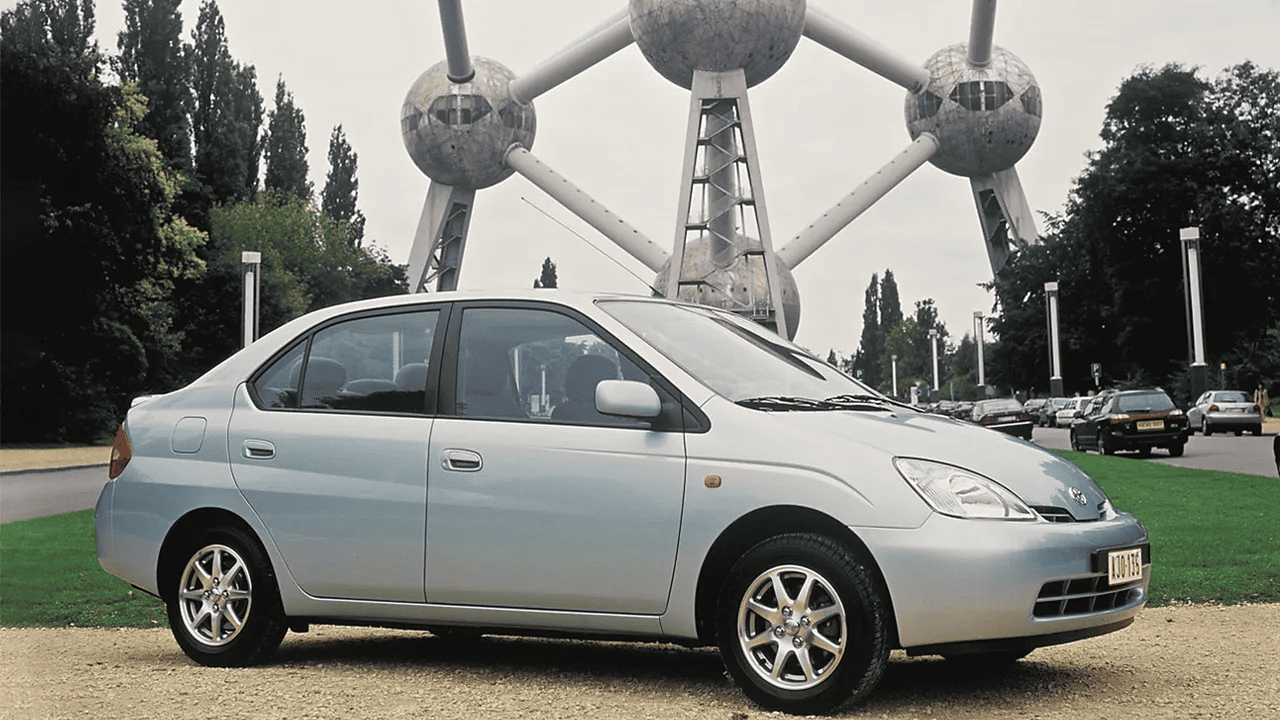
A standout example was the Toyota Prius, first introduced by Toyota in 1997. It quickly became one of the era's most iconic vehicles. The Prius was also the world's first mass-produced hybrid car, and went on to inspire the development of cutting-edge automotive technology in the years that followed.
The history of the automobile has continued to advance in positive ways, evident in the steady stream of new technologies that have emerged. These innovations have been driven by the goal of creating vehicles that are more efficient and environmentally responsible.
In Europe, governments and automotive manufacturers began incorporating filters into car engines as one strategy for producing more eco-friendly vehicles. Eventually, the use of these filters became mandatory across all European-manufactured cars, a step taken to safeguard public health.
The same approach was adopted by Toyota in Japan, which began producing eco-friendly hybrid-fuelled vehicles. The Toyota model that emerged from this initiative was named the Prius.
As one of Astra's subsidiary partners, Toyota has continued to drive innovation in its vehicle development. Its progress has shown significant advancement in technology and vehicle efficiency.
Toyota continues to focus on developing engines that are both more powerful and more fuel-efficient. The latest Toyota engines are now equipped with hybrid technology that combines a petrol engine with an electric motor.
The combination of the two delivers optimal performance with greater fuel efficiency. This innovation allows drivers to enjoy a smoother, more responsive driving experience without compromising on energy efficiency.
Toyota has also strengthened its position in the electric vehicle industry by launching a range of eco-friendly models. One such example is the bZ4X, designed to meet the needs of consumers who are increasingly aware of the importance of environmental responsibility.
This electric model offers a significant reduction in exhaust emissions, allowing it to not only reduce its negative environmental impact but also meet the increasingly stringent emission standards across various countries.
A particularly interesting feature of this vehicle is its support for advanced battery technology, enabling it to cover greater distances on a single charge.
Beyond electric vehicles, Toyota also continues to develop other eco-friendly technologies, including hydrogen and plug-in hybrid systems, giving consumers the flexibility to choose the powertrain option that best suits their needs.
With its strong commitment to building eco-friendly vehicles, Toyota remains at the forefront of the automotive industry's ongoing revolution, offering advanced mobility solutions powered by the latest technology, while remaining accountable to the environment.
ALSO READ: Eco-Friendly Cars: Cleaner Transportation Innovations
The journey through automotive history shows that transportation innovation has always been focused on technology that is more efficient, safer, and more sustainable.
If you are interested in learning more about how the automotive industry continues to evolve in response to the challenges of the future, you can explore the various sustainability initiatives undertaken by Astra through the Astra Sustainability Report.


Be part of our enthusiastic community that is interconnected in the vision of a sustainable future.