'%3e%3cpath%20fill-rule='evenodd'%20clip-rule='evenodd'%20d='M72.7386%2031.9427H70.5078V34.2699H73.5513L74.8841%2037.6969H78.3056L72.2835%2022.6738H70.4996V25.6665L72.7386%2031.9427ZM70.5078%2031.9427H68.2688L70.4265%2025.6745H70.4996V22.6818H68.7889L62.8359%2037.7049H66.038L67.3748%2034.2779H70.4996L70.5078%2031.9427Z'%20fill='%23005BAA'/%3e%3cpath%20fill-rule='evenodd'%20clip-rule='evenodd'%20d='M89.5501%2025.455C88.5675%2025.0218%2087.5025%2024.7977%2086.4253%2024.7975C85.385%2024.7975%2083.9872%2025.2319%2083.9872%2026.9095C83.9872%2029.4678%2090.7529%2028.372%2090.7529%2033.4766C90.7529%2036.7602%2088.071%2037.9995%2084.9502%2037.9995C83.3248%2037.9995%2082.569%2037.7803%2081.0046%2037.4177L81.3053%2034.7199C82.3888%2035.2638%2083.5831%2035.562%2084.7999%2035.5926C85.9905%2035.5926%2087.5508%2035.0068%2087.5508%2033.6998C87.5508%2030.7749%2080.7852%2032.0181%2080.7852%2026.9852C80.7852%2023.6299%2083.4671%2022.3906%2086.1408%2022.3906C87.4021%2022.395%2088.655%2022.5912%2089.8548%2022.9724L89.5501%2025.455Z'%20fill='%23005BAA'/%3e%3cpath%20fill-rule='evenodd'%20clip-rule='evenodd'%20d='M97.584%2025.0925H93.1914V22.6816H105.093V25.0925H100.709V37.7047H97.584V25.0925Z'%20fill='%23005BAA'/%3e%3cpath%20fill-rule='evenodd'%20clip-rule='evenodd'%20d='M113.344%2025.105C114.466%2025.2445%20115.429%2025.6829%20115.429%2026.9979C115.429%2028.4563%20114.466%2028.8947%20113.344%2029.0421V31.6682C113.795%2031.9551%20114.015%2032.3217%20114.315%2033.0549L116.176%2037.7172H119.598L117.139%2031.8794C116.847%2031.1461%20116.327%2030.3452%20115.514%2030.2854C116.384%2030.1857%20117.185%2029.7724%20117.762%2029.1258C118.339%2028.4793%20118.65%2027.6456%20118.635%2026.7867C118.635%2023.3597%20116.034%2022.8456%20113.352%2022.7021L113.344%2025.105ZM111.19%2025.105H113.344V22.7141H108.086V37.7372H111.207V31.5088H112.149C112.553%2031.4694%20112.96%2031.5198%20113.34%2031.6562V29.0302C112.946%2029.0878%20112.547%2029.1079%20112.149%2029.0899H111.186L111.19%2025.105Z'%20fill='%23005BAA'/%3e%3cpath%20fill-rule='evenodd'%20clip-rule='evenodd'%20d='M131.422%2031.9427H129.191V34.2699H132.32L133.584%2037.6969H137.001L130.979%2022.6738H129.191V25.6665L131.422%2031.9427ZM129.191%2031.9427H126.964L129.191%2025.6745V22.6818H127.484L121.531%2037.7049H124.75L126.082%2034.2779H129.207L129.191%2031.9427Z'%20fill='%23005BAA'/%3e%3cpath%20fill-rule='evenodd'%20clip-rule='evenodd'%20d='M80.9241%206.77433C77.1329%207.06523%2069.7658%208.15709%2063.7437%209.16527C57.7907%2010.1854%2054.8041%2010.9186%2052.2888%2011.5004C45.6694%2013.0346%2035.6285%2015.8838%2030.2729%2017.4778C25.5999%2019.0359%2013.1616%2024.0648%2012.7918%2023.9971C12.6415%2023.9971%2012.1904%2023.5587%2012.8609%2023.1204C11.6012%2023.9971%2031.0124%207.14492%2062.8416%202.91695V0H0V33.4732C19.334%2025.8182%2040.6104%2022.8255%2062.8457%2022.8255V14.7441L63.3699%2014.5967C76.0885%209.93037%2090.8918%208.02957%20114.911%205.55097V4.75399C112.904%204.75399%2098.0272%204.96917%2081.2207%206.79425L80.9241%206.77433Z'%20fill='%23005BAA'/%3e%3cpath%20fill-rule='evenodd'%20clip-rule='evenodd'%20d='M114.912%204.29948C103.641%203.56019%2092.3313%203.60946%2081.0676%204.44692C75.1959%204.88526%2068.9463%205.76194%2063.1477%206.71034C50.7947%208.82234%2040.5385%2011.3767%2040.5385%2011.3767C40.5385%2011.3767%2039.7908%2011.3767%2040.4613%2010.9423C41.5788%2010.2848%2050.6484%206.272%2063.1477%203.86512C65.8269%203.35506%2068.6523%202.91672%2071.6241%202.55011C72.0711%202.55011%2071.6241%202.04004%2071.6241%202.04004C68.7268%202.25921%2065.8255%202.40665%2063.0908%202.76928C51.3864%204.41589%2040.0139%207.83588%2029.3802%2012.9069C28.9332%2013.13%2030.5668%2012.1776%2021.046%2017.358C21.046%2017.358%2015.0971%2021.2233%2014.6542%2021.6617C14.0569%2022.2475%2019.5588%2019.8366%2023.4272%2018.4499C26.999%2017.2145%2036.6701%2014.5128%2038.9009%2013.8553C40.4613%2013.4209%2045.9633%2012.2613%2051.6887%2011.1575C57.0484%2010.0616%2062.1765%209.4121%2062.4772%209.34037H62.847C62.847%209.34037%2068.7268%208.45971%2069.9093%208.24054C71.7013%207.87393%2081.4455%206.71034%2081.5187%206.71034C98.3292%204.88526%20115.209%204.7418%20114.912%204.7418V4.29948Z'%20fill='%2395B6DF'/%3e%3c/g%3e%3cdefs%3e%3cclipPath%20id='clip0_118_10024'%3e%3crect%20width='137'%20height='38'%20fill='white'/%3e%3c/clipPath%3e%3c/defs%3e%3c/svg%3e)






Discover how the circular economy helps businesses reduce waste, improve efficiency, and create positive environmental impact.
Sustainability
6 mins read
0
Bagikan:
In recent years, there has been growing recognition that current consumption and production patterns are unsustainable. The linear economy model, which follows a “take, use, dispose” approach, has resulted in significant environmental harm due to waste accumulation. This awareness has prompted countries to adopt the circular economy model.
For many companies, the circular economy is more than a concept; it serves as a practical business and sustainability strategy. This article explains the circular economy and its connection to waste management.
ALSO READ: 5 Zero Waste Concepts: Change Habits, Save the Earth!
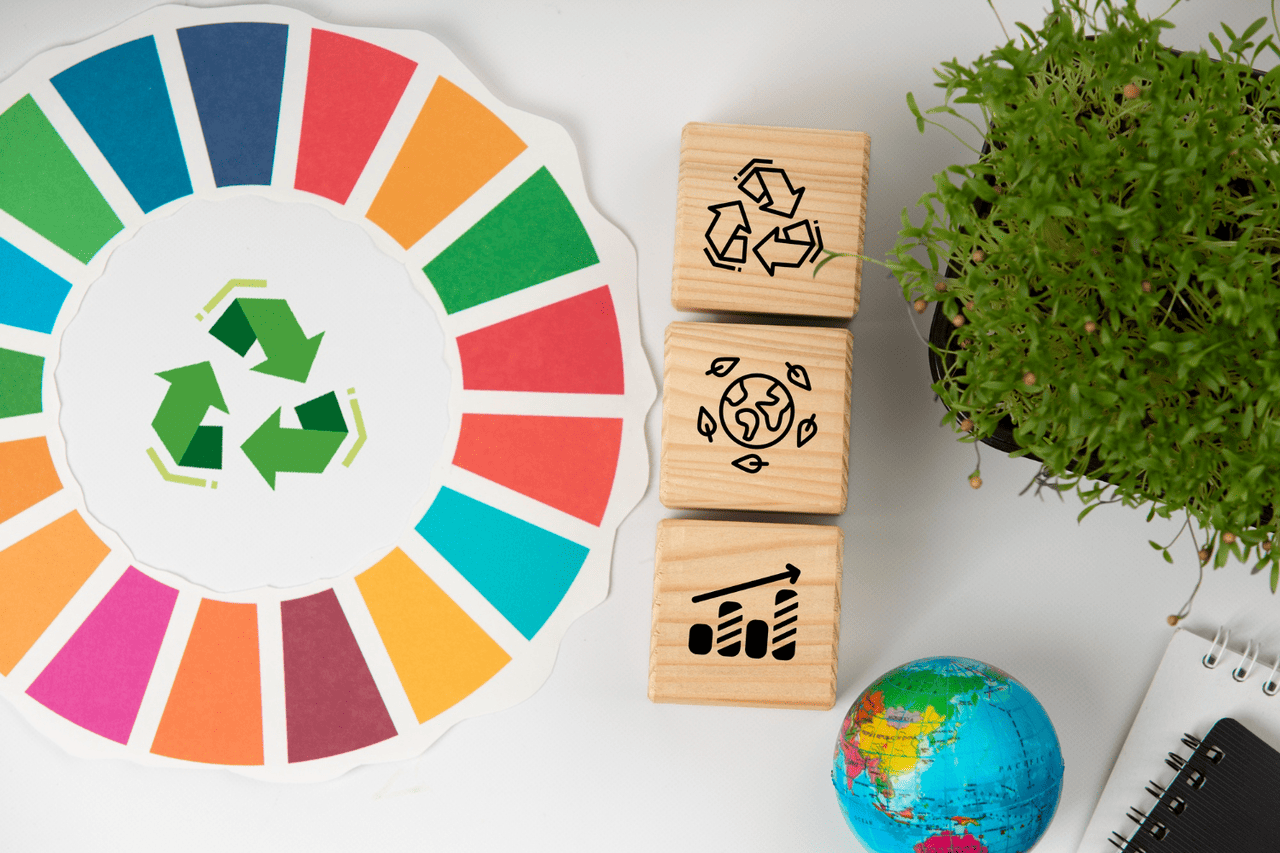
The circular economy is an economic system that prioritizes repeated resource use. Rather than discarding waste, it promotes recycling, repair, and reuse to keep resources in circulation as long as possible.
In the industrial sector, this model offers several benefits, including:
The circular economy is implemented through nine hierarchical strategies, prioritized by impact and importance. The following outlines each strategy.
1. Refuse: Reject unnecessary materials or processes from the outset.
2. Rethink: Adapt business models to improve efficiency and reduce waste.
3. Reduce: Minimize raw material and energy use in production.
4. Reuse: Reuse products in their original form.
5. Repair: Repair damaged products so they can be used again.
6. Refurbish: Restore used products to optimal condition.
7. Remanufacture: Assemble used components into new products.
8. Repurpose: Repurpose products for different uses.
9. Recycle and Recover: Convert materials into new raw materials or recover energy from non-recyclable waste.
Key advantages of implementing a circular economy include the following:
Implementing a circular economy reduces waste. This is because the model allows products and materials to be redesigned to maximize their lifespan, enable repairs, and return materials into the production cycle.
This can reduce the need for new raw materials, decrease waste generation, and reduce environmental pressure.
Another advantage is that it encourages innovation in product and service design.
Companies are encouraged to rethink business models, such as offering products as services that support repair, maintenance, and reuse. These innovations can drive sustainable economic growth and create new business opportunities.
This economic model also promotes efficient resource use by extending product lifecycles and encouraging recycling and reuse practices. As a result, it reduces demand for limited natural resources.
Basically, this economic model benefits the environment and economy, and can also improve social welfare. By improving access to goods and services through inclusive business models, the circular economy can help reduce social inequality and increase accessibility for underprivileged communities.
Reducing reliance on limited natural resources and minimizing market instability can strengthen economic resilience. Moreover, reuse and recycling can help address fluctuations in raw material prices while providing long-term production stability.
Lastly, the circular economy also supports green growth by encouraging investment in environmentally friendly technologies and infrastructure. This approach creates opportunities for green industries and expands the market for sustainable products and services.
In Indonesia, the circular economy is part of the national development strategy. It is included in the 2025–2045 National Long-Term Development Plan (RPJPN) as a pathway to a green economy, supported by several legal frameworks, including:
The government has identified five priority sectors for this transition: food, textiles, construction, retail (especially plastic packaging), and electronics. If fully implemented by 2030, these sectors could significantly increase Gross Domestic Product (GDP) and create new green jobs.
The 2025–2029 National Medium-Term Development Plan (RPJMN) also targets a gradual annual increase in the circular material input rate for the industrial sector. Within this framework, contributions from individual companies, including PT Astra International Tbk, are essential to advancing the national circular economy.
Through its subsidiary FIFGROUP, PT Astra International Tbk launched the #AKSI: Let’s Reduce Indonesia’s Waste campaign to raise awareness of waste management among employees and the public as part of circular economy and waste reduction efforts.
This program is part of the implementation of SDG Goal 12 – Responsible Consumption and Production. FIFGROUP initiated this campaign to promote waste management awareness among employees and the public using circular economy principles.
Programs under this campaign include:
This program has been implemented at the FIFGROUP Head Office and all branches, involving all employees. As a result, FIFGROUP achieved a 19.4% reduction in waste generation.
Waste is recorded and sorted before being distributed to Astra-assisted waste banks, which serve as partners in recycling and community empowerment.
In addition to these programs, PT Astra International Tbk has achieved the following results in 2025:
Tangible benefits of implementing the circular economy include:
In summary, the circular economy offers a solution to move beyond the resource-intensive linear model. Through its programs, PT Astra International Tbk demonstrates a strong commitment to waste reduction and delivers economic, social, and environmental benefits.
Individuals and businesses can adopt practices from PT Astra International Tbk’s initiatives, such as sorting household waste and supporting waste banks.
If you want to learn more about PT Astra International Tbk’s sustainability programs, you can directly read the Astra Sustainability Report. Because a cleaner future for the planet can only be achieved if we all take part.


Be part of our enthusiastic community that is interconnected in the vision of a sustainable future.