'%3e%3cpath%20fill-rule='evenodd'%20clip-rule='evenodd'%20d='M72.7386%2031.9427H70.5078V34.2699H73.5513L74.8841%2037.6969H78.3056L72.2835%2022.6738H70.4996V25.6665L72.7386%2031.9427ZM70.5078%2031.9427H68.2688L70.4265%2025.6745H70.4996V22.6818H68.7889L62.8359%2037.7049H66.038L67.3748%2034.2779H70.4996L70.5078%2031.9427Z'%20fill='%23005BAA'/%3e%3cpath%20fill-rule='evenodd'%20clip-rule='evenodd'%20d='M89.5501%2025.455C88.5675%2025.0218%2087.5025%2024.7977%2086.4253%2024.7975C85.385%2024.7975%2083.9872%2025.2319%2083.9872%2026.9095C83.9872%2029.4678%2090.7529%2028.372%2090.7529%2033.4766C90.7529%2036.7602%2088.071%2037.9995%2084.9502%2037.9995C83.3248%2037.9995%2082.569%2037.7803%2081.0046%2037.4177L81.3053%2034.7199C82.3888%2035.2638%2083.5831%2035.562%2084.7999%2035.5926C85.9905%2035.5926%2087.5508%2035.0068%2087.5508%2033.6998C87.5508%2030.7749%2080.7852%2032.0181%2080.7852%2026.9852C80.7852%2023.6299%2083.4671%2022.3906%2086.1408%2022.3906C87.4021%2022.395%2088.655%2022.5912%2089.8548%2022.9724L89.5501%2025.455Z'%20fill='%23005BAA'/%3e%3cpath%20fill-rule='evenodd'%20clip-rule='evenodd'%20d='M97.584%2025.0925H93.1914V22.6816H105.093V25.0925H100.709V37.7047H97.584V25.0925Z'%20fill='%23005BAA'/%3e%3cpath%20fill-rule='evenodd'%20clip-rule='evenodd'%20d='M113.344%2025.105C114.466%2025.2445%20115.429%2025.6829%20115.429%2026.9979C115.429%2028.4563%20114.466%2028.8947%20113.344%2029.0421V31.6682C113.795%2031.9551%20114.015%2032.3217%20114.315%2033.0549L116.176%2037.7172H119.598L117.139%2031.8794C116.847%2031.1461%20116.327%2030.3452%20115.514%2030.2854C116.384%2030.1857%20117.185%2029.7724%20117.762%2029.1258C118.339%2028.4793%20118.65%2027.6456%20118.635%2026.7867C118.635%2023.3597%20116.034%2022.8456%20113.352%2022.7021L113.344%2025.105ZM111.19%2025.105H113.344V22.7141H108.086V37.7372H111.207V31.5088H112.149C112.553%2031.4694%20112.96%2031.5198%20113.34%2031.6562V29.0302C112.946%2029.0878%20112.547%2029.1079%20112.149%2029.0899H111.186L111.19%2025.105Z'%20fill='%23005BAA'/%3e%3cpath%20fill-rule='evenodd'%20clip-rule='evenodd'%20d='M131.422%2031.9427H129.191V34.2699H132.32L133.584%2037.6969H137.001L130.979%2022.6738H129.191V25.6665L131.422%2031.9427ZM129.191%2031.9427H126.964L129.191%2025.6745V22.6818H127.484L121.531%2037.7049H124.75L126.082%2034.2779H129.207L129.191%2031.9427Z'%20fill='%23005BAA'/%3e%3cpath%20fill-rule='evenodd'%20clip-rule='evenodd'%20d='M80.9241%206.77433C77.1329%207.06523%2069.7658%208.15709%2063.7437%209.16527C57.7907%2010.1854%2054.8041%2010.9186%2052.2888%2011.5004C45.6694%2013.0346%2035.6285%2015.8838%2030.2729%2017.4778C25.5999%2019.0359%2013.1616%2024.0648%2012.7918%2023.9971C12.6415%2023.9971%2012.1904%2023.5587%2012.8609%2023.1204C11.6012%2023.9971%2031.0124%207.14492%2062.8416%202.91695V0H0V33.4732C19.334%2025.8182%2040.6104%2022.8255%2062.8457%2022.8255V14.7441L63.3699%2014.5967C76.0885%209.93037%2090.8918%208.02957%20114.911%205.55097V4.75399C112.904%204.75399%2098.0272%204.96917%2081.2207%206.79425L80.9241%206.77433Z'%20fill='%23005BAA'/%3e%3cpath%20fill-rule='evenodd'%20clip-rule='evenodd'%20d='M114.912%204.29948C103.641%203.56019%2092.3313%203.60946%2081.0676%204.44692C75.1959%204.88526%2068.9463%205.76194%2063.1477%206.71034C50.7947%208.82234%2040.5385%2011.3767%2040.5385%2011.3767C40.5385%2011.3767%2039.7908%2011.3767%2040.4613%2010.9423C41.5788%2010.2848%2050.6484%206.272%2063.1477%203.86512C65.8269%203.35506%2068.6523%202.91672%2071.6241%202.55011C72.0711%202.55011%2071.6241%202.04004%2071.6241%202.04004C68.7268%202.25921%2065.8255%202.40665%2063.0908%202.76928C51.3864%204.41589%2040.0139%207.83588%2029.3802%2012.9069C28.9332%2013.13%2030.5668%2012.1776%2021.046%2017.358C21.046%2017.358%2015.0971%2021.2233%2014.6542%2021.6617C14.0569%2022.2475%2019.5588%2019.8366%2023.4272%2018.4499C26.999%2017.2145%2036.6701%2014.5128%2038.9009%2013.8553C40.4613%2013.4209%2045.9633%2012.2613%2051.6887%2011.1575C57.0484%2010.0616%2062.1765%209.4121%2062.4772%209.34037H62.847C62.847%209.34037%2068.7268%208.45971%2069.9093%208.24054C71.7013%207.87393%2081.4455%206.71034%2081.5187%206.71034C98.3292%204.88526%20115.209%204.7418%20114.912%204.7418V4.29948Z'%20fill='%2395B6DF'/%3e%3c/g%3e%3cdefs%3e%3cclipPath%20id='clip0_118_10024'%3e%3crect%20width='137'%20height='38'%20fill='white'/%3e%3c/clipPath%3e%3c/defs%3e%3c/svg%3e)






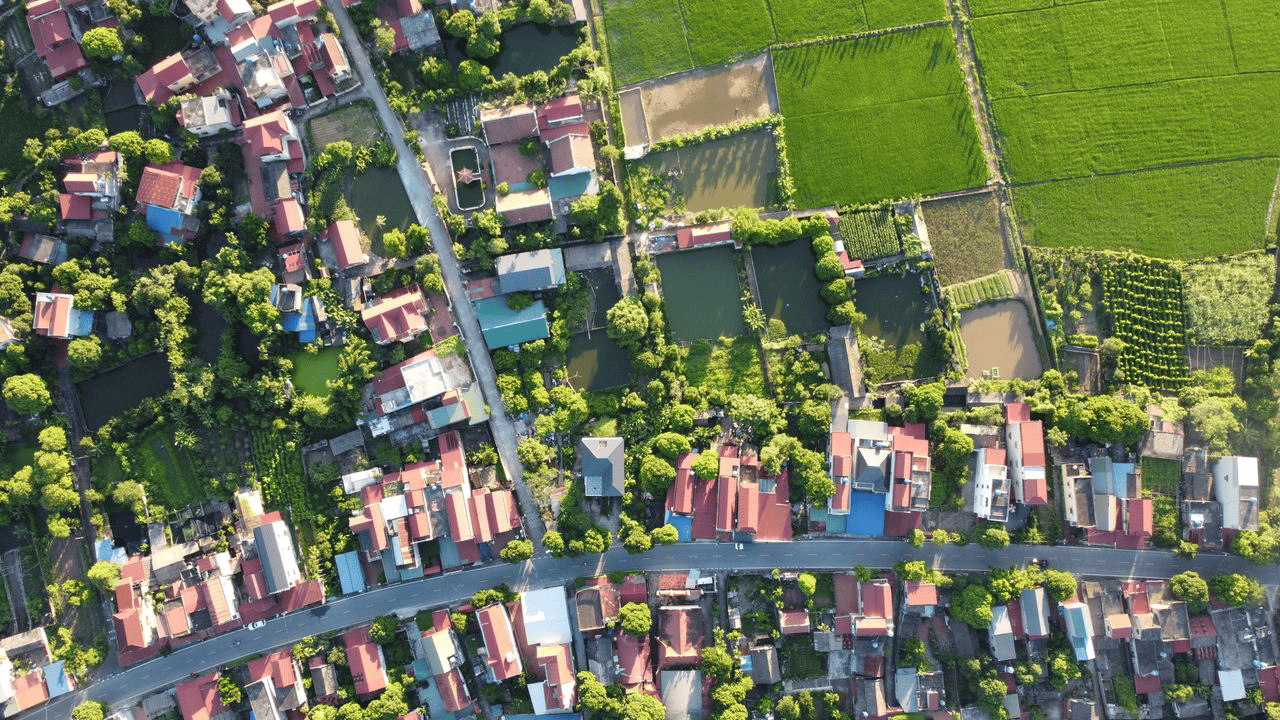
Smart villages drive inclusive, sustainable rural development by bringing together technology, governance, and community empowerment.
Program Kontribusi Sosial
5 mins read
0
Bagikan:
Village development today goes far beyond simply building physical infrastructure. In this era of digital transformation, villages are also expected to harness technology, strengthen governance, and empower their communities to become more self-reliant and competitive. This is the idea behind what's known as a smart village.
With this concept, a village is not just the target of development. It becomes a driver of economic, social, and environmental growth.
ALSO READ: Understanding Independent Villages: Pillars Towards a Sustainable Society
A smart village is a village development concept that uses digital technology, good governance, innovation, and community participation to improve public services, boost economic well-being, and support environmental sustainability.
Unlike conventional village development, a smart village is not just about going digital. The concept also emphasizes collaboration among local government, communities, the private sector, academics, and various community groups to tap into local potential.
This can show up across several areas, such as:
A smart village is generally built on several key pillars, including:
Village governments use technology to improve transparency, efficiency, and the quality of public services. This can include digital village administration, online document processing, village information systems, and budget transparency.
The next pillar is smart economy. In practice, economic empowerment becomes the main focus, driven through the development of small businesses, agriculture, tourism, and digitally enabled local products.
Common examples include digital marketing for village products, an online marketplace for small businesses, digital-based village tourism, and entrepreneurship training.
Building human capital happens through education, training, and digital literacy improvement. Program examples include information technology training, entrepreneurship education, skill building for younger generations, and financial literacy.
Smart environment is another essential pillar of a smart village. This means managing natural resources responsibly, to ensure their long-term benefits, whether through integrated waste management, environmental conservation, or sustainable farming.
Smart mobility refers to an eco-friendly transportation system built on advanced technology, including electronic, computing, and telecommunications systems.
The goal is to make transportation more convenient and efficient, in terms of time, cost, and effort.
Smart living focuses on improving people's quality of life through better access to basic services, such as digital healthcare, distance learning, internet infrastructure, and community security systems.
Here are some of the key benefits of adopting the smart village concept:
Building an effective smart village takes a combination of digital infrastructure, stronger community capacity, multi-stakeholder collaboration, and participatory governance. Without active involvement from villagers themselves, even the most advanced technology won't create a lasting impact.
Here are the general steps typically taken to bring a smart village to life:
In line with its commitment to sustainable village development, PT Astra International Tbk runs a range of initiatives that share the same spirit as the smart village concept, developing villages in an integrated way through collaboration and community empowerment.
One of its flagship programs is Desa Sejahtera Astra (DSA). Rather than focusing on short-term aid, this program builds village self-reliance by strengthening local economic ecosystems, expanding access to education and healthcare, and preserving the environment.
The program is carried out in collaboration with village stakeholders to ensure that the solutions implemented genuinely fit local community needs. Astra also runs various community empowerment initiatives through the SATU Indonesia Awards, which champion innovation in health, education, environment, entrepreneurship, and technology across different regions of Indonesia.
This approach strengthens the role of young people as agents of change in village development. As of 2025, PT Astra International Tbk has:
These initiatives show that sustainable village development depends not only on technology, but also on strengthening community capacity, cross-sector collaboration, and unlocking local potential.
ALSO READ: Knowing the Creative Village Program: Innovation for the People's Future
A smart village is a village development concept that brings together technology, good governance, innovation, and community empowerment to build villages that are more self-reliant, inclusive, and sustainable. Through this approach, villages can improve the quality of their public services, strengthen their local economy, develop their human resources, and protect the environment.
However, the success of a smart village is not determined by technology alone. It also depends on collaboration among all stakeholders to build community capacity and make the most of local potential. With the right strategy, a village can become a center of growth that benefits its community while supporting sustainable national development.
The commitment to sustainable village development has become part of PT Astra International Tbk's broader sustainability strategy. Through various community empowerment programs, including Desa Sejahtera Astra, PT Astra International Tbk continues to strengthen local economies, education, healthcare, the environment, and entrepreneurship to create a lasting, positive impact.
Learn more about how PT Astra International Tbk carries out these initiatives through the Astra Sustainability Report.


Be part of our enthusiastic community that is interconnected in the vision of a sustainable future.