






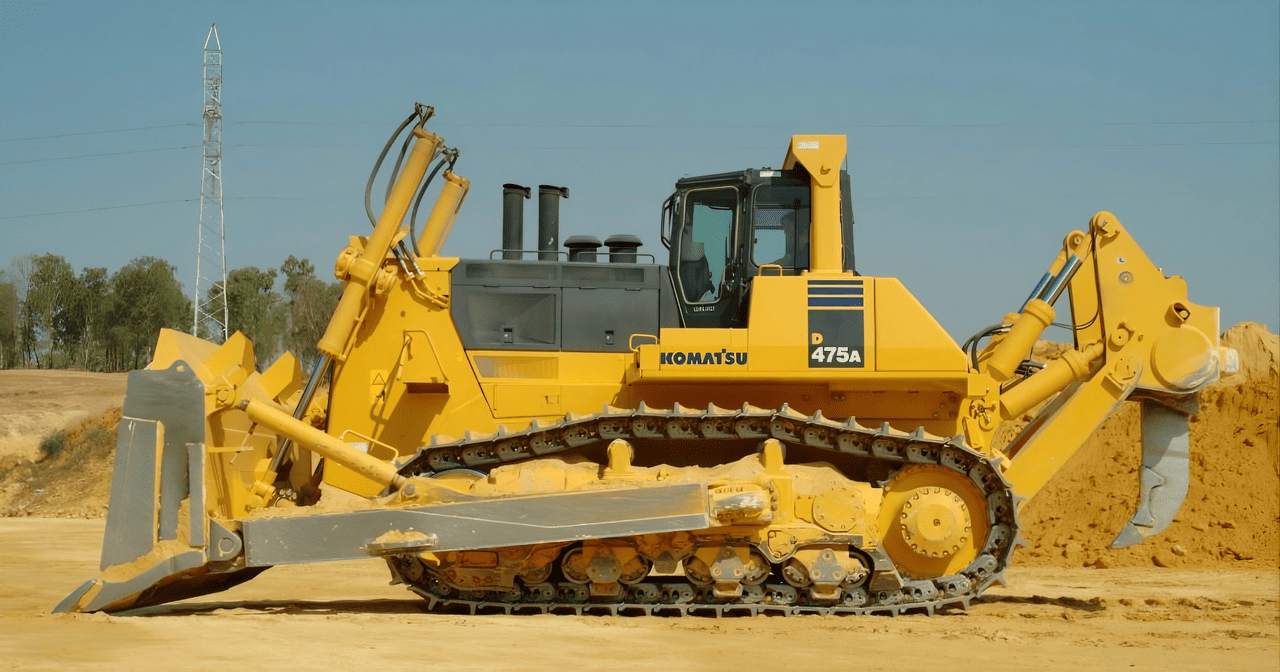
A bulldozer is a mainstay of construction and mining projects. Learn what it does, how it works, and the types.
Others
5 mins read
0
Bagikan:
Construction and mining projects rely on heavy equipment to move large volumes of material. A bulldozer is one of the machines frequently used for this work.
With its powerful engine and large front blade, a bulldozer pushes, levels, and moves materials across a range of terrain. So, what are the main functions, and which types are commonly used?
ALSO READ: 12 Types of Heavy Equipment and Their Roles Across Industries
A bulldozer is a heavy machine designed for moving, pushing, shallow digging, and leveling materials. The defining feature is a large blade mounted at the front.
The blade handles soil, sand, rocks, debris, and other materials around a jobsite.
Some bulldozers also have a rear-mounted ripper. The tooth or claw-shaped attachment breaks up hard ground or materials before they are moved.
These features make bulldozers widely used in construction and mining. For example, the tracks on a crawler bulldozer provide traction and stability when working on uneven, muddy, or unstable ground.
Here are some of the main jobs a bulldozer performs.
One of the most familiar uses of a bulldozer is pushing material. The front blade allows large quantities of soil, sand, rocks, debris, and other loose materials.
Bulldozers are most effective at moving materials over relatively short distances. For longer hauls, projects typically use other equipment specifically designed for transportation.
Bulldozers help with grading, or shaping the ground's surface. Operators adjust the blade to cut down raised areas or move material from higher ground to lower areas.
This work is part of site preparation, road construction, and other activities that require the ground to be brought to a specified elevation.
Although bulldozers are not the primary equipment for deep excavation, as excavators are, they use their blades for shallow digging.
This may include digging certain types of ditches, shaping contours, or directing drainage. This capability is particularly useful when excavation also involves moving materials a short distance.
In addition to cutting down raised areas, bulldozers push material into areas that need fill. Operators then spread the material to help shape the site.
A bulldozer, therefore, does more than move material from one point to another. It also helps prepare the ground to meet the project's requirements.
Bulldozers equipped with a ripper break up compacted soil or hard surfaces before the material is moved.
Usually mounted at the rear, a ripper works by driving its teeth into the material. Different configurations suit different tasks. For example, a single-shank ripper concentrates force at one point, while a multi-shank ripper covers a wider area.
ALSO READ: What Is an Excavator? Learn About Heavy Construction Tools
A bulldozer has several components that work together to deliver pushing power and maneuverability on the jobsite. Here is what each one does.
Bulldozers are classified by their undercarriage, size, or blade configuration. Here are some types commonly used on projects.
A crawler bulldozer runs on tracks rather than wheels. These tracks provide traction and stability on rough, uneven, or soft ground. Crawler bulldozers are widely used in construction, land clearing, road building, and mining.
A mini bulldozer has a compact design that allows it to work in tighter spaces. Although it has less capacity than a larger bulldozer, the smaller size offers greater flexibility and maneuverability.
This type handles tasks such as small-scale land clearing, site cleanup, and work in areas with limited operating space.
A straight blade, or S-blade, has a relatively straight profile and is generally used for digging, clearing, and leveling materials.
This blade is useful for working with firmer materials and performing grading tasks that require relatively precise control.
A semi-U blade combines features of a straight blade and a universal blade. The shape balances material-carrying capacity with control. The blade handles a range of material-moving and filling tasks, including backfilling.
An angled blade is set to direct material to either side. This configuration is useful for shaping the ground, digging ditches, or moving material in a specific direction.
Blade selection should take site conditions and project requirements into account, as each design offers different capabilities.
ALSO READ: What Is a Crane? Learn About Lifting Equipment for Construction
Bulldozers play a key role throughout many stages of a project, particularly when powerful equipment is needed to shape the ground and move materials over short distances.
To learn more about solutions for your heavy equipment and industrial operations needs, explore Astra's Mining and Heavy Equipment Solutions business. We provide construction machinery and heavy equipment solutions for the mining, plantation, construction, and forestry sectors.
The business also covers mining solutions, construction machinery, mining contracting, construction, and energy. Find out more here.


Be part of our enthusiastic community that is interconnected in the vision of a sustainable future.